How to tailor your CV to a job description, step by step
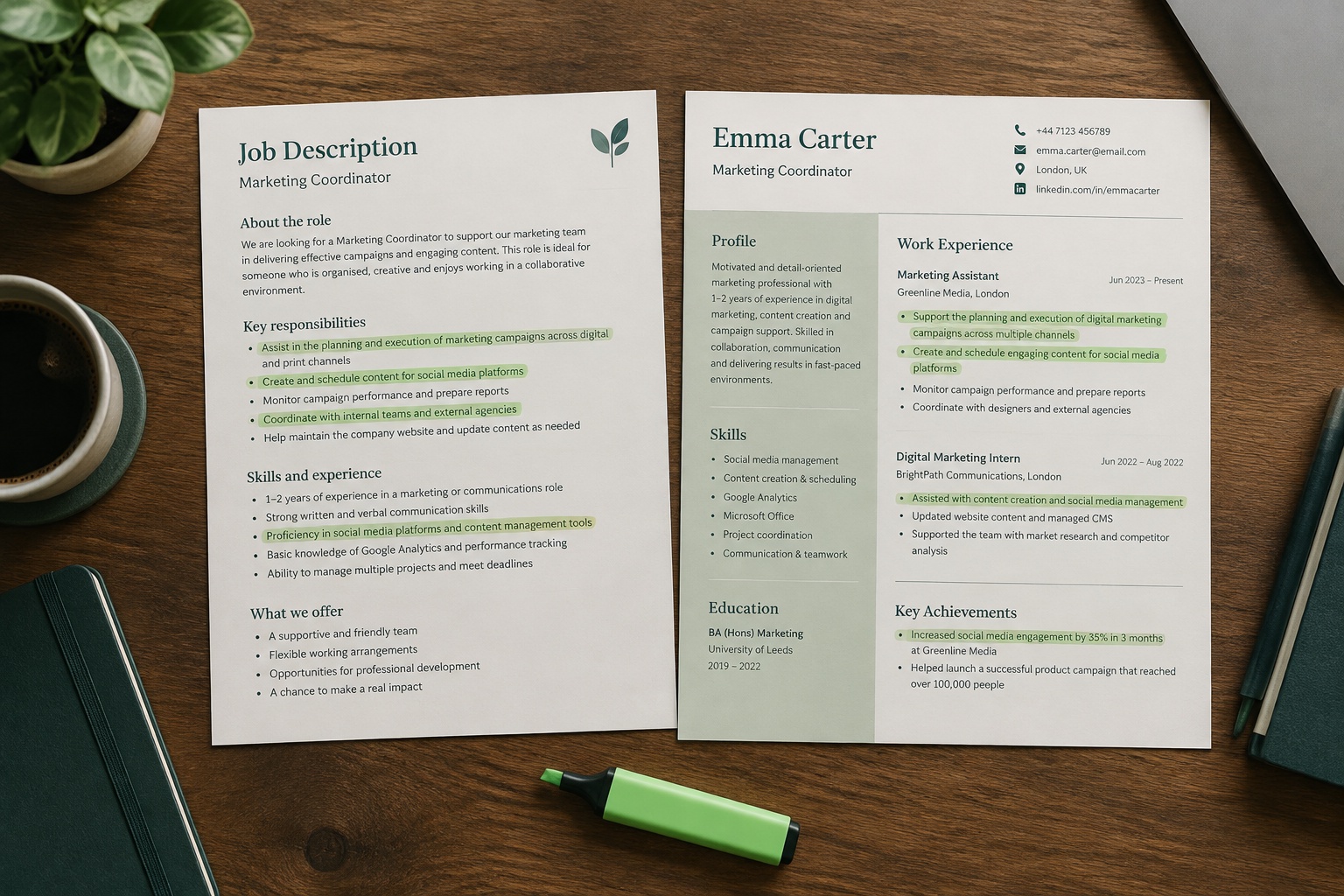
Sending the same CV to every job is the most common reason good candidates get passed over. Tailoring doesn't mean rewriting your CV from scratch each time. It means making the right evidence easy to find.
Why tailoring matters
In Robert Walters research, 62% of hiring managers said lack of relevant experience was the main reason for rejecting applications (Onrec, April 2025). Often the experience is there, but the CV doesn't make it obvious. Tailoring fixes that.
Step 1: Break down the job description
Highlight:
- the essential requirements (these are what you're screened on)
- the desirable requirements
- repeated words and phrases, which usually signal what matters most
- the level: team size, budget, stakeholders, scope

Step 2: Make a keyword list
Note the exact terms the advert uses, including job titles, skills, methods and tools, and any common variations. For example, an advert might say "stakeholder engagement" where your CV says "working with senior leaders".
Step 3: Match your evidence to each requirement
For every essential requirement, find a real example from your experience. If you can't find one, that's a gap. Be honest about it, and decide whether you can explain it in your cover letter or interview.
Step 4: Rewrite your profile
Your profile, the short summary at the top, should speak directly to this role. Mention the job's level, your most relevant experience and one or two achievements that match what they need.
Step 5: Reorder and reword your bullet points
- Move the most relevant achievements to the top of each role.
- Use the advert's language where it truthfully describes what you did.
- Start each bullet with what you did and end with the result, ideally with a number.
Before: "Responsible for managing projects across the business."
After: "Led a portfolio of 12 change projects across four departments, delivering all key milestones on time and within budget."
Step 6: Cut what doesn't help
Older or unrelated roles can be shortened to a line each. Two pages is the usual length for a UK CV, so make every line earn its place.
Step 7: Check it as the employer would
Read the job description, then your CV. Could someone see in 30 seconds that you meet the essential requirements? If not, move the evidence higher.
Getting through applicant tracking systems (ATS)
- Use a clean layout: standard headings, no tables, text boxes or images for key information.
- Include the advert's important keywords, in context.
- Save as the file type the application asks for, usually PDF or Word.
Quick questions
Fewer applications. Better ones.
Build your career profile with Katie, get an honest fit check, and a CV written from your real experience.